Absentee Shawnee Tribal Opioid Response (TOR)
|
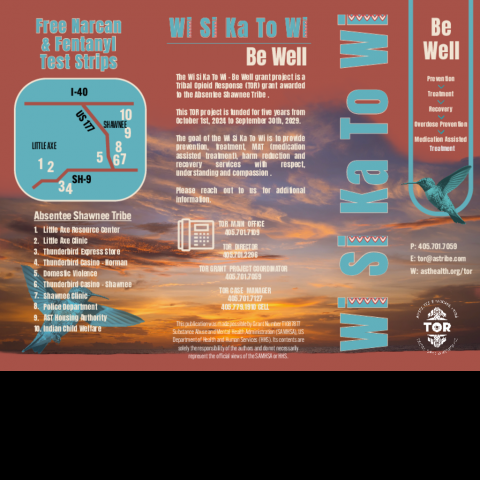
The Wi Si Ka To Wi Project The Wi Si Ka To Wi Project is a federally funded Tribal Opioid Response (TOR) initiative designed to address the opioid epidemic through culturally responsive, evidence-based interventions that are tailored to the needs of Native American communities. The project focuses on prevention, treatment, recovery support, and overdose deterrence while promoting holistic wellness and long-term recovery. Services Provided Prevention -Educational materials and presentations are provided to the public, school districts, First Responders, Public Safety officers, and other surrounding organizations to raise awareness of substance misuse and reduce initiation of opioids and fentanyl.
Treatment -TOR assists eligible individuals with 30-day detox/rehabilitation placement into substance use treatment programs, including Medication-Assisted Treatment (MAT). When grant funding is unavailable for private-pay services, TOR Program works to secure placement through state-funded and tribal treatment facilities. Below are some resources that Wi Si Ka To Wi Project uses to ensure treatment:
By leveraging a network of public, tribal, and private treatment partners, TOR Program strives to ensure that financial barriers do not prevent individuals from accessing quality care and treatment services.
Overdose Deterrence -Free naloxone (Narcan) kits are available to the general public, regardless of age or tribal affiliation, in order to support overdose prevention throughout the community. TOR staff also provides trainings and demonstrations on how to administer naloxone for any program and/or organization interested. Narcan kiosks can be found at the following locations:
Recovery Support -The Wi Si Ka To Wi Project facilitates weekly talking circles that are rooted in Wellbriety principles, healing through cultural connection, peer support, and holistic wellness. These circles encourage participants to strengthen their physical, mental, emotional, and spiritual well-being while building a supportive recovery community. TOR staff also works closely with clients to ensure they remain engaged in recovery by helping transport them to required medical appointments, court obligations, treatment services, and other recovery-related activities (when available*). Through comprehensive case management, community partnerships, and culturally grounded support, the Wi Si Ka To Wi Project seeks to empower individuals and families on their journey toward lasting recovery and wellness. TOR Program Eligibility Services are available to any federally recognized American Indian/Alaska Native individuals within the Absentee Shawnee Tribal Health System service area (Cleveland/Pottawatomie/Oklahoma/Lincoln/Logan County), who can provide proof of tribal citizenship and is affected by opioid and/or methamphetamine use disorder. *Individuals interested in treatment, recovery support services, prevention resources, or overdose prevention supplies are encouraged to contact the Wi Si Ka To Wi Project directly for eligibility screening, referrals, and additional program information. |
|
|
This publication was made possible by Grant Number T1087877 Substance Abuse and Mental Health Administration (SAMHSA), US Department of Health and Human Services (HHS). Its contents are solely the responsibility of the authors and do not necessarily represent the official views of the SAMHSA or HHS. |
|
CONTACT US
Michaela Tuberville, Case Manager
Office: 405.701.7059
Work Cell: 405.779.1910
Greg Palmer, Case Manager
Office: 405.561.7813
Work Cell: 405.368.1988
Amanda Upshaw, TOR Director
Office: 405.701.7038
Work Cell: 405.432.6453
NATIONAL Resources
National Institutes of Health (NIH)
Substance and Mental Health Services Administration (SAMHSA)
Addiction Technology Transfer Network
National Institute for Mental Health
Native Center for Behavioral Health
Overdose Prevention Strategy – US Department of Health and Human Services